The newly released 2027 CPT Professional Edition includes the final code descriptors, definitions, and reporting instructions for the new unattended sleep testing code family that takes effect Jan. 1, 2027.
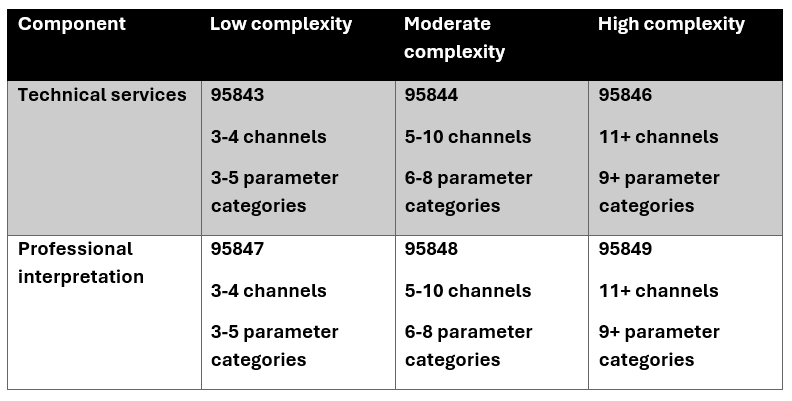
The new framework replaces Current Procedural Terminology (CPT) codes 95800, 95801, and 95806 with six codes that separate the technical portion of unattended sleep testing from the physician or other qualified healthcare professional interpretation and report. Code selection is based on the number of clinically relevant channels recorded and the number of parameter categories generated, with the lower of the two determining the appropriate complexity level.
New unattended sleep testing codes
What's new in the 2027 CPT manual?
In addition to the code descriptors, the updated sleep medicine testing guidelines provide important information to help practices apply the new codes, including:
- New and revised definitions for channels, parameter categories, direct and derived measures of sleep, interpretation, technical analysis, epochs, sleep testing, and other key terms.
- Examples of qualifying channels, such as airflow, oxygen saturation, respiratory effort, position, movement,
- electroencephalography (EEG), electrooculography (EOG), electromyography (EMG), electrocardiography (ECG), photoplethysmography, and peripheral arterial tonometry.
- A new parameter-category framework covering sleep summary, sleep stages, oxygen measures, obstructive sleep apnea (OSA) and non-OSA respiratory indices, cardiac and movement indices, positional measures, and other categories.
- Clarification on counting parameters: Multiple measures within the same category, such as apnea-hypopnea index (AHI), respiratory disturbance index (RDI), and respiratory event index (REI), count as one parameter category, not three.
- Code-selection instructions specifying that the appropriate complexity level is determined by the lower of the channel count or parameter-category count.
- Additional reporting guidance clarifying that code selection is based on clinically relevant information, not simply the number of signals a device can collect or its capabilities.
Members may send questions about CPT guidance on the new codes to coding@aasm.org.