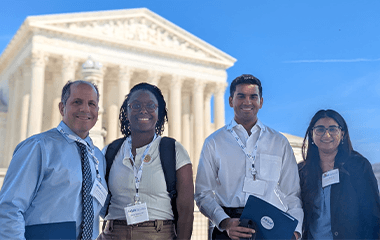
On April 14, AASM members gathered on Capitol Hill to advocate for policies advancing sleep medicine. Members from several AASM committees and groups, including the Advocacy Committee, Political Action Committee (PAC) Advisory Panel, Public Safety Committee, Coding and Reimbursement Advisory Committee, Early Career Physician Assembly, and the Board of Directors, met with legislators and their staff to discuss issues affecting the sleep field. The day concluded with a reception for members and invited guests.
Issues that were a focus during meetings this year included:
Physician payment
Physician payment has steadily declined, negatively impacting members and their practices, and it consistently ranks among AASM members’ top advocacy priorities. AASM members discussed the importance of implementing long-term fixes to Medicare regulations governing payment for sleep-related services. This included advocating for support for legislation addressing different aspects of the medical payment system:
- HR 8163, the Provider Reimbursement Stability Act, would modernize budget-neutrality rules to reduce volatility in the Medicare Physician Fee Schedule.
- HR 7520, the Efficiency Adjustment Delay Act, would delay efficiency-related relative value unit adjustments by the Centers for Medicare & Medicaid Services until at least Jan. 1, 2030.
- HR 6160, the Strengthening Medical for Patients and Providers Act, would provide an annual inflationary update tied to the Medicare Economic Index.
Congressional offices expressed interest in the AASM’s specific policy recommendations to address the disconnect between the current system and the stability health care professionals need.
Permanent standard time
In recent years, debate over permanent standard time versus permanent daylight saving time has increased. Members urged legislators to oppose efforts to impose permanent daylight saving time and instead support legislation establishing permanent standard time. Members cited evidence showing that permanent standard time supports healthier sleep patterns, reduces medical errors, and improves safety during morning commutes.
Legislators and staff expressed strong interest in the issue, recognizing that sleep medicine professionals are uniquely positioned to provide expert policy guidance.
Rural residency program funding
Supporting the future of the field requires continued investment in programs that expand the physician workforce, particularly in rural communities. H.R. 6468, the Rural Residency Planning and Development Act of 2025, would provide dedicated funding for rural residency programs, including those that feed into the sleep field, helping address geographic disparities in access to care.
Congressional offices, including those representing less-rural districts, showed interest in codifying the program and acknowledged the need for expanded access to medical care in underserved areas.
Other topics discussed included prior authorization, funding for sleep research, and visa fee relief for physicians.
The AASM holds at least one Hill Day each year, providing members with opportunities to advocate directly with legislators and their staff on policies that advance the sleep field and address public health issues affecting the nation. Members can continue these efforts by participating in online advocacy campaigns addressing Hill Day priorities and other state and federal legislative issues.
The AASM PAC serves as a key tool supporting the AASM’s advocacy efforts. In addition to Hill meetings, members representing the AASM PAC met with several legislators throughout the day to discuss issues critical to sleep medicine.
“Without physician advocacy, policy gets written without us. The AASM PAC ensures we are at the table — protecting patients, payment, and the future of our field,” said Colleen Lance, MD, a member of the AASM PAC Advisory Panel.
AASM members are encouraged to join the AASM PAC Capitol Club with a $250 donation and attend the Capitol Club reception at SLEEP 2026.
* Federal law requires that we use our best efforts to collect and report the name, mailing address, occupation and name of employer of individuals who contribute to the AASM PAC. Checks or credit cards donations must be from a non-corporate account. Contributions are not deductible as charitable contributions for federal income purposes. Contributions are voluntary and do in no way affect membership or other status in the American Academy of Sleep Medicine. Only U.S. citizens may contribute to the AASM PAC.
(Pictured above: Andrew Namen, MD, FCCP, FAASM; Bianca Stewart, MD; Ayan De, MD; Jasmin Singh, MD)