Season 8 | Episode 2
In this episode of Talking Sleep, host Dr. Seema Khosla welcomes three members of the World Sleep Society’s consumer health technology task force—Dr. Michael Chee from Singapore, who chaired the task force; Dr. Mathias Baumert from Australia; and Dr. Cathy Goldstein from the University of Michigan—to discuss their global recommendations for the use of consumer sleep technology and wearable health trackers.
Consumer wearables have become ubiquitous in clinical practice, with patients routinely sharing device data. While some clinicians have historically dismissed this information, attitudes are shifting as technology improves and rigorous research examines sensors, algorithms, and data quality. Dr. Chee explains that the recommendations are designed for multiple audiences: end-users, clinicians, researchers, and manufacturers, with specific guidance for each group.
The conversation addresses practical considerations: the assumption that users have good perfusion, how bed partners can influence movement detection, and the fundamental truth that the best device is one patients will actually wear properly. The panel discusses recent FDA regulatory changes and clarifies whether guidance applies only to non-FDA cleared wellness devices or has broader implications.
The experts systematically review which measurements are most reliable, from bedtime and wake time to total sleep time. They introduce TATS (total attempted time in sleep) and explain what clinicians should know about sleep onset and offset detection. An intriguing discussion explores “tapigraphy”—using smartphone screen-on times to detect sleep patterns—and why this potentially more accurate method hasn’t been widely integrated despite being technically feasible.
The episode emphasizes the call for standardized Fundamental Sleep Measures and greater transparency about test populations used in device validation. Dr. Baumert discusses the need to co-create benchmarks for measurement accuracy across different contexts—from persons with normal sleep to shift workers to those with sleep disorders.
Practical clinical applications receive detailed attention: How can wearables augment care for patients with insomnia, sleep apnea, or circadian rhythm disorders? What can photoplethysmography (PPG) reveal beyond sleep stages, including arterial stiffness and blood pressure trends? Are finger-based devices more reliable than wrist-worn trackers? The experts clarify these are not standalone diagnostic devices but tools that augment clinical visits with longitudinal data.
Looking toward the future, the panel discusses emerging capabilities including temperature monitoring for fertility and illness detection, arterial stiffness assessments, and challenges of integrating massive amounts of wearable data into electronic medical records.
Whether you’re skeptical about consumer wearables or seeking guidance on interpreting patient-generated data, this episode provides evidence-based recommendations for moving forward responsibly.
Join us for this important discussion about embracing consumer sleep technology while maintaining clinical rigor.
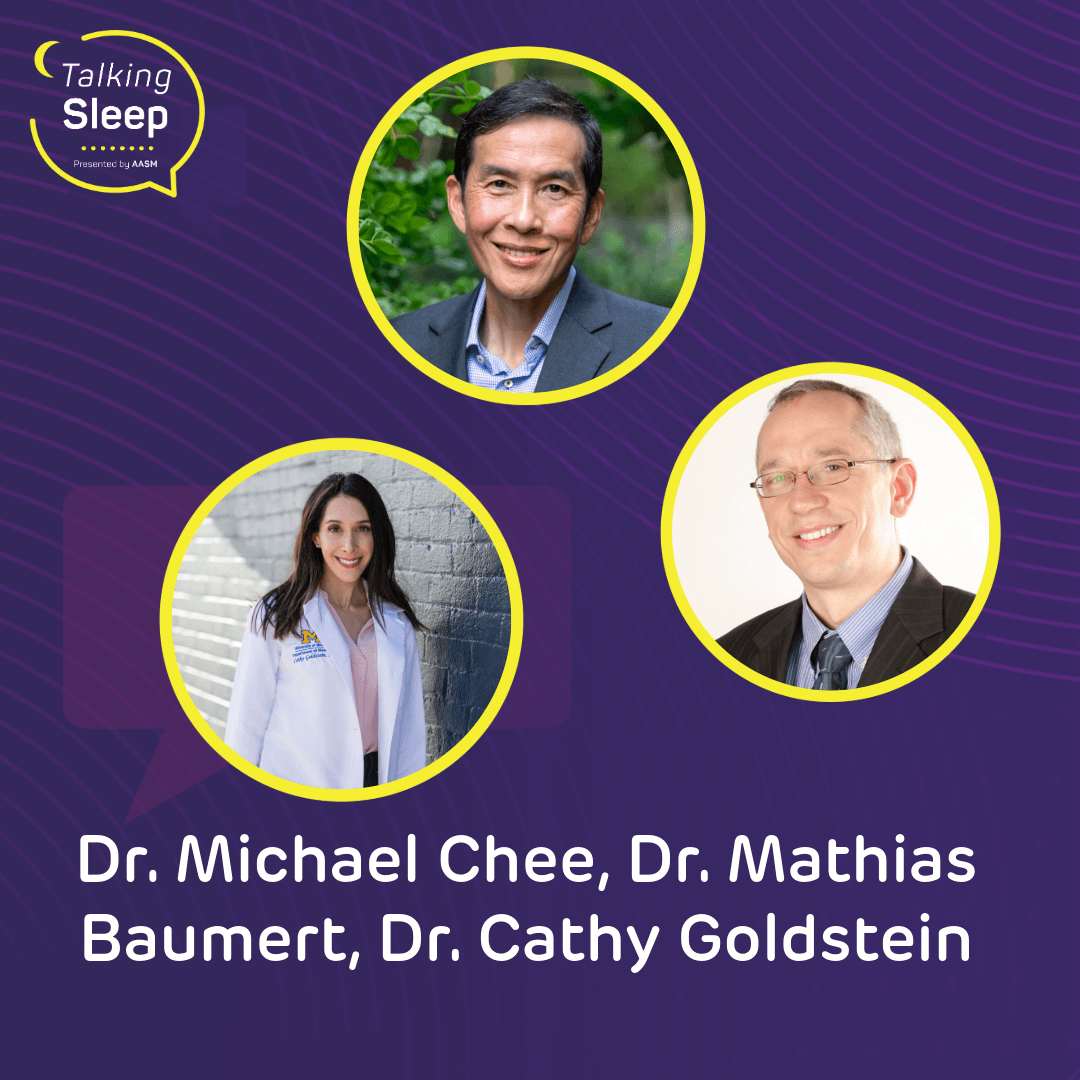
Cathy Goldstein, M.D.
Cathy Goldstein, M.D. is a Professor of Neurology at the University of Michigan Sleep Disorders Center, Co-Director of the Division of Sleep Medicine, and faculty lead of the Eisenberg Family Depression Center Mobile Technologies Core and the University of Michigan Mobile Technology Research Innovation Collaborative (MeTRIC).
Dr. Goldstein’s research uses consumer-facing sleep tracking devices and mathematical modeling to assess sleep patterns and circadian rhythms in the ambulatory, day-to-day setting to determine their role in health and disease (including in women’s reproductive health, multiple sclerosis, and gastrointestinal conditions). Her international expertise in sleep tracking technology is highlighted by her role as one of the lead authors of the ‘State of the Science and Recommendations for Using Wearable Technology in Sleep and Circadian Research’ from the Sleep Research Society (SRS) and “World Sleep Society recommendations for the use of wearable consumer health trackers that monitor sleep” from the World Sleep Society.
She serves the sleep community as one of the senior editors of the sleep field’s sentinel text, Principles and Practice of Sleep Medicine, and additionally, holds editorial roles for UpToDate and the Journal of Clinical Sleep Medicine. She was previously the chair of the American Academy of Sleep Medicine (AASM)’s Artificial Intelligence in Sleep Medicine Committee and speaks globally in this area.
Dr Goldstein educates a variety of learners including training physicians, peer groups, athletes (and athletic staff), and the public via numerous media outlets (CNN, New York Times, Time) and podcasts.
Dr. Mathias Baumert
Associate Professor Mathias Baumert leads the Biomedical Engineering Discipline at Adelaide University. His research focuses on biomedical signal processing for the development of digital biomarkers and the translation of these novel methodologies into clinical practice, with particular emphasis on sleep and cardiovascular health.
He is a Fellow of the IEEE Fellow and has authored more than 130 peer-reviewed publications spanning sleep research, biomedical engineering, cardiology, physiology, and neuroscience. He received his PhD from the Technical University of Ilmenau, Germany, in 2005, and has been awarded fellowships from the Australian Research Council, including an Australian Postdoctoral Fellowship and an Australian Research Fellowship, as well as a Career Development Award from the National Health and Medical Research Council of Australia.
He serves as Executive Editor of Biomedical Signal Processing and Control and is a member of the Editorial Board of the Proceedings of the IEEE.
Professor Michael Chee, MBBS, FRCP(Edin)
Professor Michael Chee, MBBS, FRCP(Edin) is the Director of Centre for Sleep and Cognition at the National University of Singapore Yong Loo Lin School of Medicine. He is a pioneer clinician-scientist in Singapore who has won the National Outstanding Clinician-Scientist Award (2009) and is a three-time award winner of the National Medical Research Council’s top tier Clinician-Scientist STaR award (2007, 2013, 2019). He is an inaugural Fellow of the Organisation for Human Brain Mapping.
As an esteemed Sleep Researcher, Professor Michael Chee’s work on sleep over the last 20 years has focused on characterising and alleviating the negative impact of sleep deprivation on cognitive performance, wellbeing and health using innovative cognitive tests as well as a wide range of instrumentation including EEG, MRI, wearable devices, and ecological momentary assessments. His team ran 5 editions of the adolescent ‘Need for Sleep Studies’ – a 2-week sleep camp investigating the effects of different doses of sleep on vigilance, memory and mood.
Renowned as a leading Sleep Researcher, he has led work on non-invasive stimulation technologies to enhance sleep, a series of intervention studies involving sleep education and starting school later to help adolescents sleep longer, developed smartphone apps to assess time use and to probe sleep and daytime wellbeing, as well as multiple papers investigating the neural mechanisms of sleep loss as well as the benefit of naps. His 200+ publications include contributions to Ann Rev Psychol, PNAS, Neuron, J Neuroscience, Am J Psychiatry, Neurology, Sleep and NeuroImage. His research has attracted over $50 million in funding as Principal Investigator.
In the sleep field, he has served as Vice President (2013-2014) and President (2016-2018) of the Singapore Sleep Society, given plenary or keynote talks at top conferences such as World Sleep, Organization for Human Brain Mapping and the American Academy of Sleep Medicine, consulted for AIA and presently sits on the editorial boards of Sleep, Imaging Neuroscience and Current Opinion in Behavioral Sciences.
He has also written numerous commentaries on sleep and public health and has appeared on television, internet, and international print media in relation to his advocacy work for sleep, which has been cited by the Times, Guardian, Economist, and other influential lay press publications. He has also trained over 80 research staff including 4 Associate Professors, 7 Assistant Professors, numerous research fellows as well as a few medical doctors, clinical psychologists, and founders of two tech start-ups.
Resources
-
- Chee MW, Baumert M, Scott H, Cellini N, Goldstein C, Baron K, Imtiaz SA, Penzel T, Kushida CA; World Sleep Society Sleep Tracker Task Force. World Sleep Society recommendations for the use of wearable consumer health trackers that monitor sleep. Sleep Med. 2025 Jul;131:106506. doi: 10.1016/j.sleep.2025.106506. Epub 2025 Apr 5. PMID: 40300398.
- de Zambotti M, Goldstein C, Cook J, Menghini L, Altini M, Cheng P, Robillard R. State of the science and recommendations for using wearable technology in sleep and circadian research. Sleep. 2024 Apr 12;47(4):zsad325. doi: 10.1093/sleep/zsad325. PMID: 38149978.